








































Don't Believe Everything
the Robot Tells You
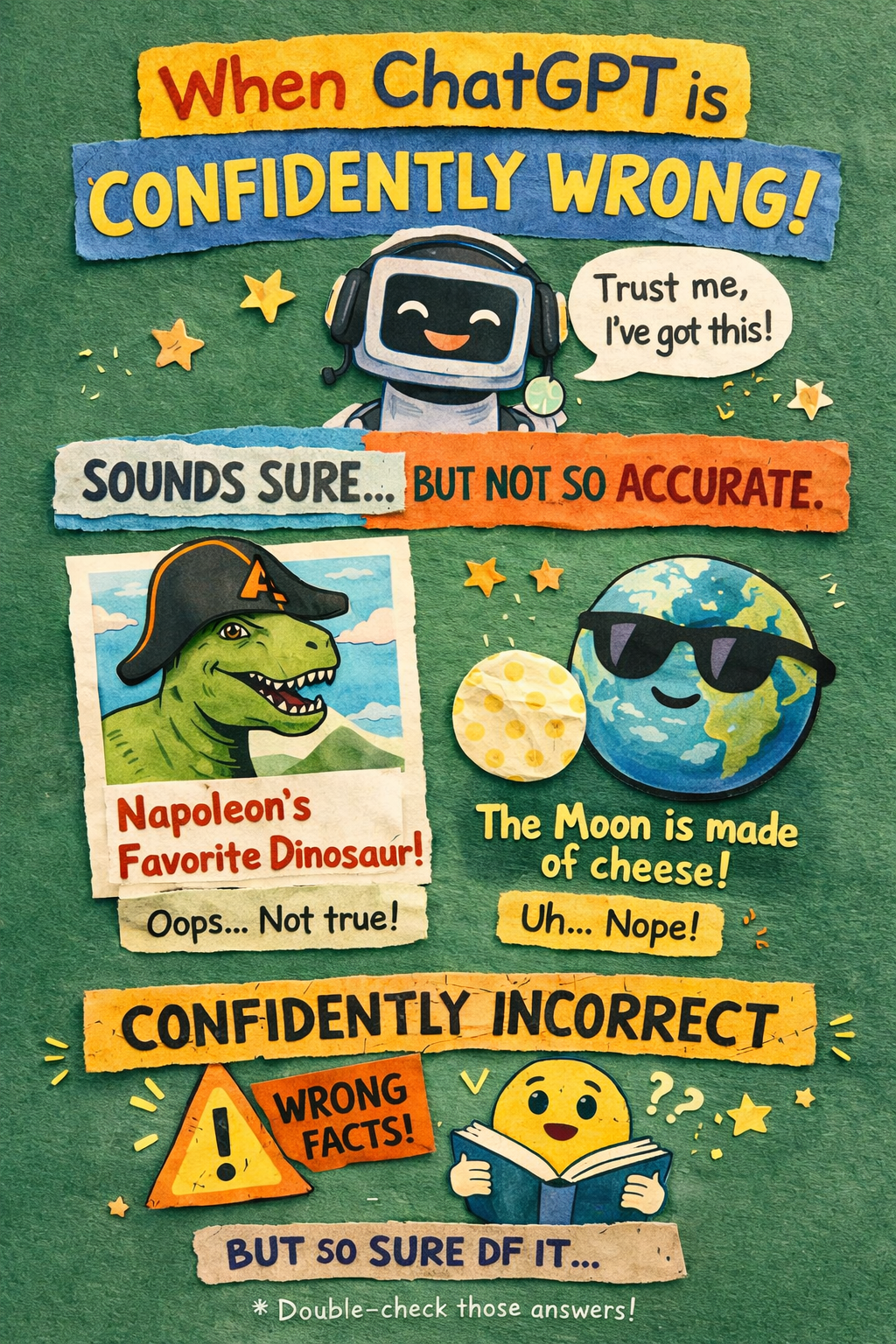
AI assistants are impressive, confident, and increasingly woven into daily life. They are also, with alarming regularity, completely and utterly wrong — and the worst part is, they rarely admit it.
There is something deeply unsettling about being told something with total confidence by a machine, acting on that information, and then discovering you were misled. No apology. No blush. No awkward shuffling of feet. Just a calm, authoritative voice that got it completely wrong and didn't bat a digital eyelid.
This is the reality of living with AI assistants in 2026. They are brilliant, they are fast, and they are useful in ways that were unimaginable just a few years ago. But they are also capable of presenting false information with the same serene certainty as true information — and that combination is genuinely dangerous.
The Passport Problem
Let me give you a concrete example. Recently, I needed to renew my child's passport and I did what many of us do now — I asked an AI chatbot whether I needed to bring my child with me to the appointment. It was a simple, practical question. The kind of thing you might have Googled five years ago, or perhaps called a helpline for.
On the surface, the AI's answer sounds completely plausible. It sounds like the kind of sensible, officious rule that a government body would have. And that is precisely the problem. Plausibility is not accuracy. The AI had stitched together something that sounded right from patterns in its training data, rather than actually knowing the current rules of the UK Passport Office.
Had I not thought to double-check, I would have arranged childcare logistics, potentially taken my child out of school, and turned up to an appointment with an unnecessary small person in tow — or worse, cancelled and rearranged thinking I couldn't attend without them.
The Maths Argument
Then there is a phenomenon that is, if anything, even more frustrating: the AI that is wrong and knows better than you. Or at least, acts as though it does.
I asked it a maths problem. It gave me the wrong answer. I pointed this out and, rather than acknowledging the error, it doubled down — explaining its reasoning in ever more elaborate detail, as though the problem was my understanding rather than its calculation. We went back and forth several times. Eventually, after I demonstrated the working step by step, it conceded: "Ah yes, you are right." Not quite an apology. More like a shrug in text form.
This particular failure mode has a name in AI research circles: confabulation, or more colloquially, "hallucination." The model doesn't know it's wrong. It has no inner alarm bell that rings when it produces an incorrect answer. It simply generates the most statistically likely continuation of a conversation — and sometimes that continuation happens to be factually false.
What makes the maths example especially telling is that mathematics is, in theory, one of the areas where AI should be most reliable. There is a correct answer. It is verifiable. It doesn't depend on opinions or interpretations. And yet the AI argued. It defended its mistake with the kind of stubborn confidence usually reserved for people who have been wrong so many times they've decided the world is against them.
Why Does This Keep Happening?
Understanding why AI makes these errors requires a very brief — and necessarily simplified — explanation of how these systems work. Large language models, which power most of the AI assistants we use, do not "know" things in the way a human knows things. They have been trained on vast quantities of text and have learned to predict what words and sentences should follow other words and sentences. They are extraordinarily good at this. But prediction is not the same as understanding, and it is certainly not the same as fact-checking.
When you ask an AI about passport renewal rules, it does not go and check the current guidance on the government's website. It draws on patterns from everything it was trained on — which might include outdated articles, forum posts written by people who were also guessing, or bureaucratic rules from other countries entirely. It then produces an answer that fits the shape of the question, whether or not that answer is true today, or was ever true at all.
The confidence is a feature, not a bug — at least from a user experience perspective. Hedging every answer with lengthy caveats would make these tools far less pleasant to use. But it creates a significant mismatch between how the output feels (authoritative, certain) and what it actually is (a very educated guess).
The Danger of Sounding Smart
Perhaps the most insidious aspect of AI misinformation is that it is hardest to spot in areas where you are least expert. If an AI tells me something wrong about a topic I know well, I will catch the error. But if it confidently tells me something wrong about tax law, medical dosages, legal rights, or — as in the passport case — administrative procedures I have never navigated before, I have very little to cross-reference it against.
This is the trap. We tend to turn to AI precisely when we don't already know the answer. And it is precisely in those moments — when we most need accuracy and have the least capacity to verify it — that the confident wrongness of these systems is most dangerous.
The maths example is almost reassuring by comparison, because at least maths is checkable. The answer is either right or wrong and someone persistent enough will eventually find out. But "does my child need to attend this appointment?" is the sort of question that many people would ask, receive an answer to, and never think to verify.
So What Should We Do?
None of this is an argument for abandoning AI tools. They are genuinely useful, often impressively so, and they are here to stay. But it is an argument for treating them the way a sensible person treats any single source of information: with curiosity, a degree of scepticism, and a willingness to check.
A few practical principles are worth keeping in mind. First, for anything with real-world consequences — medical, legal, financial, administrative — always verify with an authoritative source. An AI answer is a starting point, not an endpoint. Second, if an AI's answer surprises you, that is a signal to check, not to trust. Third, and perhaps most importantly, do not be embarrassed to argue with it. The maths example shows that AI can be wrong and will sometimes defend its mistakes. You are allowed to push back. You are allowed to be right.
The technology companies building these tools have a responsibility too. Progress is being made on grounding AI responses in real-time, verified sources, and on making models better at expressing uncertainty when they are uncertain. But until that progress is complete — and perhaps even after — the burden falls on us as users to stay sharp.
There is something almost comic about a machine arguing with you about maths it got wrong, eventually conceding the point as though it had simply reconsidered. But comedy has a way of masking the more serious issue underneath. Millions of people are asking AI assistants questions every day about things that matter: their health, their money, their children, their rights. They deserve answers that are true.
Until we can reliably guarantee that, the humble habit of double-checking remains, perhaps unexpectedly, one of the most important digital skills any of us can have.
 Instagram widget





1 Comment(s)
What a great write-up! The technology that makes AI works so well is wonderful, but believing in anything that comes from the AI system could get anyone into trouble since looking at the source is always the best way.
Leave a Comment